







Ema-ject® is now approved for use in Spotted Gums Corymbia maculata.
Spotted Gums are a popular amenity and a valuable commercial tree species in Australia.
Spotted Gum Lerp (SGLP Eucalyptoma maideni) infestations are widespread affecting tree health and vulnerability to diseases.
Effect of treatments on mortality of Spotted Gum Lerp Psyllid on 26th February (36DAT) and 16th April 2023 (85DAT).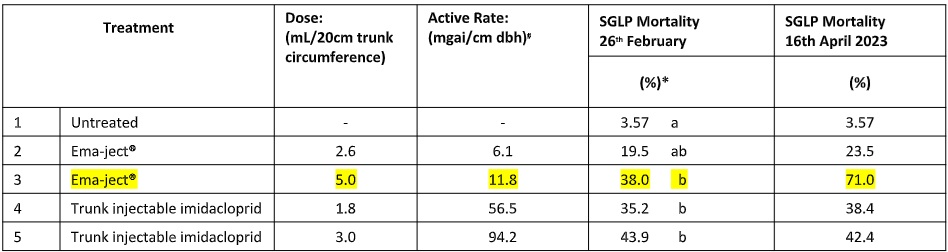
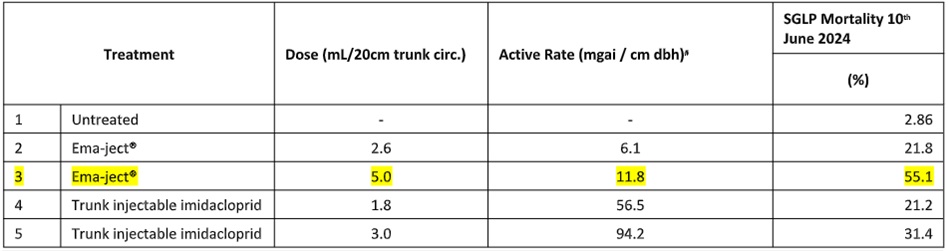
Effect of treatments on mortality of Spotted Gum Lerp Psyllid on 10 th June 2024 (17MAT)
Ema-ject® Displays Environmental Safety in APVMA Submitted Studies
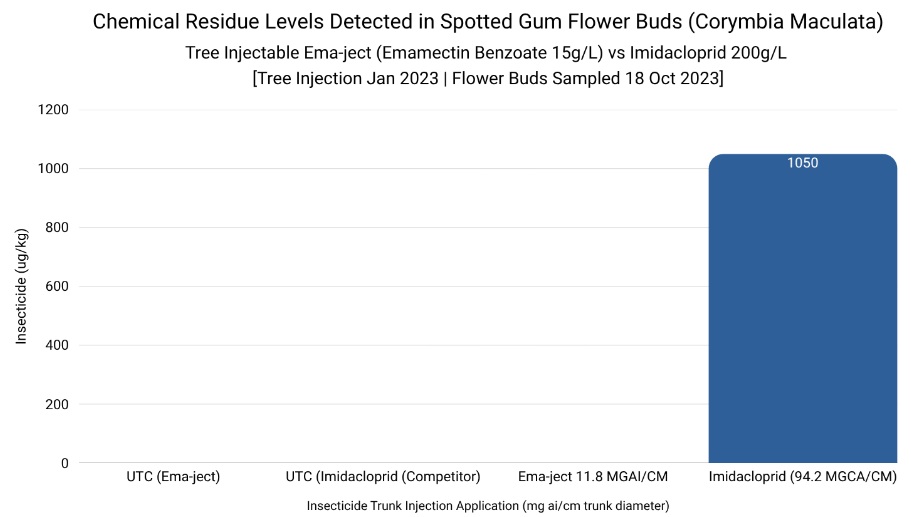
Testing on buds, nectar and pollen revealed no residues in all floral components. Tree injectable Imidacloprid was detected at lethal levels throughout the trials including the second year flowering post injection application. The label on tree injectable imidacloprid recommends treatment post flowering but makes no mention of the subsequent second year flowering or its potential residues. This situation is a risk to pollinators such as honey bees and the many indigenous bee species that feed on nectar and pollen. Bird Species such as various Honeyeater and Parrot species such as Rainbow Lorikeets and Musk Lorikeets. All frequent Corymbia Species when in flower. The outcome of imidacloprid residue ingestion is unknown in birds.
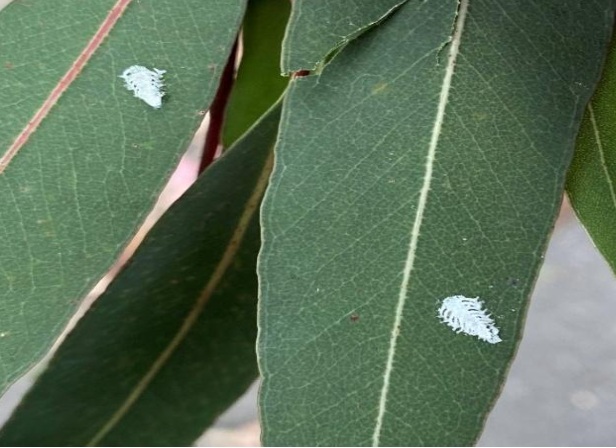
SGLP Spotted Gum Lerp Eucalyptoma maideni
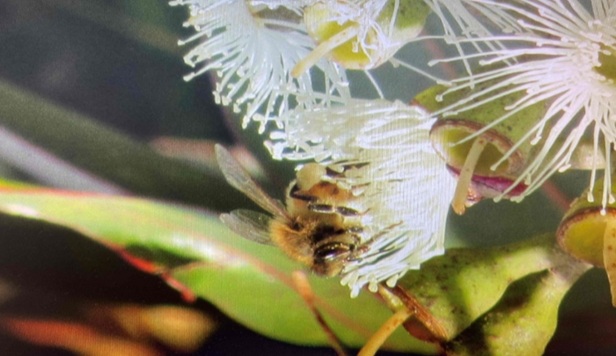
Honey Bee feeding 10/06/2024-Spotted Gum Flowers
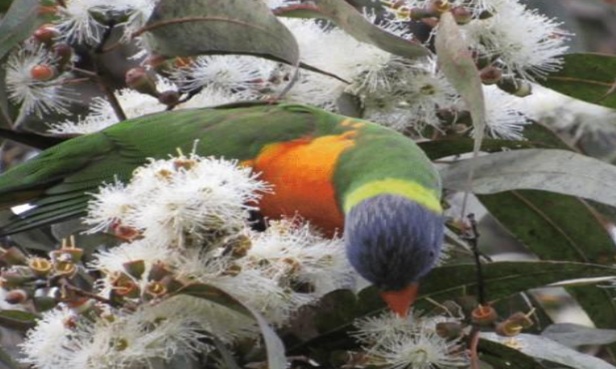
Rainbow Lorikeet feeding Spotted Gum Flowers 04/06/2024
Avian toxicity is unknown in high consuming specialised nectar feeders. Mammals such as Fruit bats consume high levels of nectar per bodyweight with residues passing through in their excrement. Bat camps are usaully located near waterways, with high bat numbers the potential of significant residue leaching poses a severe to critical risk to aquatic invertibrates.
Residue analysis of emamectin benzoate and imidacloprid in Corymbia flower buds collected on 18th October 2023 (9MAT) APVMA Submitted data.
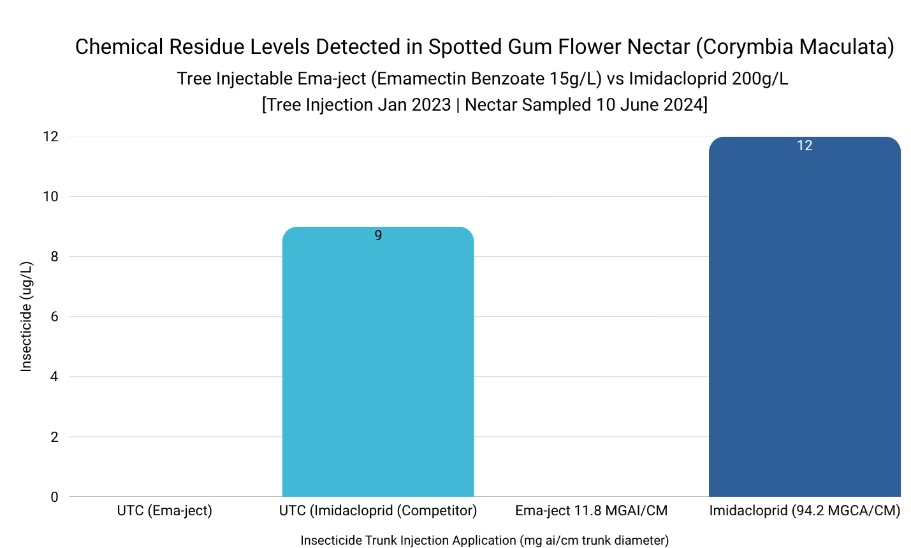
Residue analysis of emamectin benzoate and imidacloprid in Corymbia flower nectar collected on 10th June 2024 (17MAT) APVMA Submitted data.
Note: imidacloprid cross contamination in the UTC (Non treated control trees) is also documented in eucalyptus species.
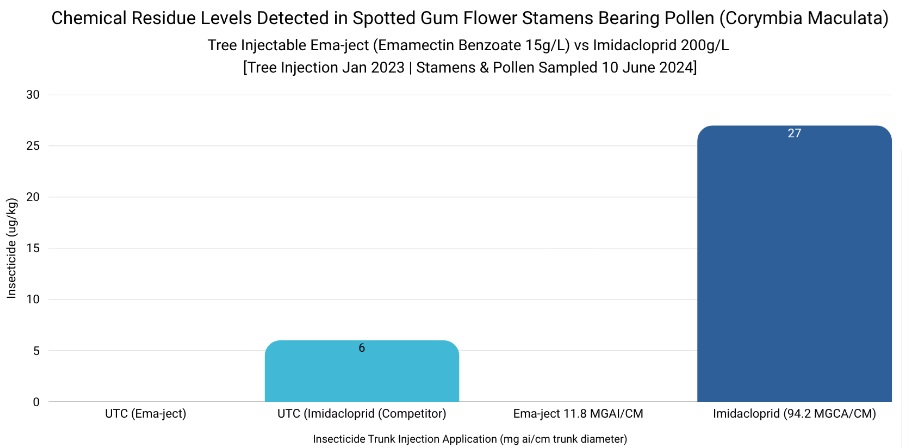
Residue analysis of emamectin benzoate and imidacloprid in Corymbia flower anthers-pollen collected on 10th June 2024 (17MAT) APVMA Submitted data.
The presence of imidacloprid in flowers potentially has consequences for non-target fauna. During the collection of flowers on 10 th June 2024, bees (Apis mellifera) were observed visiting flowers and rainbow lorikeets (Trichoglossus moluccanus) were observed feeding on flowers 04/06/2024. Other animals that could potentially contact Corymbia flowers are bats, honeyeater birds, native bees and other insect species.
In this study, the untreated control trees had residual imidacloprid in both anthers-pollen and nectar which may have been spread by animal vectors.
According to Suchail et al (2000), the oral median lethal dose (LD50) of imidacloprid after 24 and 48 hours was determined to be 5.4 ng/bee (nanograms per bee). In another experiment, Schmuck et al. (2001) obtained acute LD50 (48 h) values ranging between 3.7 and 40.9 ng/bee. Recovered imidacloprid nectar residues in our study were 12 micrograms/L (equivalent to 12µL/L). Bees ingest nectar typically at 12uL per day. Corymbia trees typically flower for at least 5 weeks (35 days).12uL x 35 days = 420uL or 0.42mL of nectar ingested by bees that forage every day on flowering Corymbia. Example: 0.42mL/1000mL x 12 micrograms of imidacloprid = 0.00504 micrograms = 5.04 ng imidacloprid per bee. This amount is within the lethal dose range of imidacloprid to kill 50% of bees, as stated by Suchail et al (2000). Sub lethal effects may occur earlier at lower levels of exposure, and bee losses through directional impairment are likely according to numerous studies. Bees returning to the hive and suppling accumulated nectar and pollen would potentially put a hive at risk via lethal and sub-lethal effects.
For more information about the benefits of Ema-ject®, contact us today.
